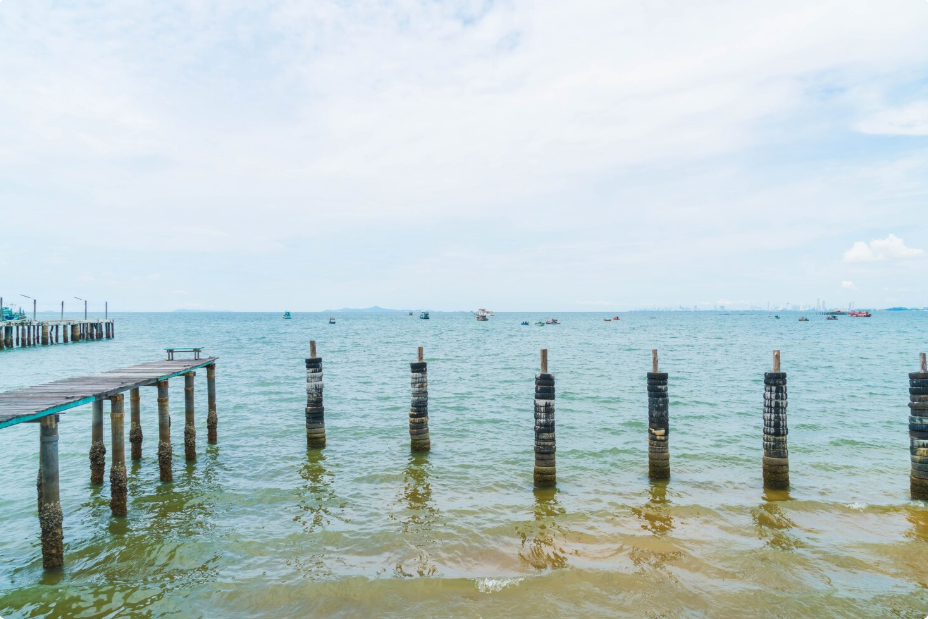
One of the most crucial choices a community or owner of coastal property can make is how to safeguard a shoreline. Installing bulkhead coastal protection or maintaining and improving natural shorelines are two popular strategies that frequently disagree with one another. The best option relies on long-term objectives, risk tolerance, and environmental factors. Each approach has advantages and disadvantages.
The Benefits of Bulkhead Coastal Protection
In order to stop land erosion, bulkheads—vertical or almost vertical structures—are constructed along the shoreline. They are frequently employed in situations where there is a shortage of space or if property loss has already taken place because they establish a clear boundary between land and water.
Upland areas can be stabilized and immediate erosion can be controlled with bulkhead coastal protection. Bulkheads frequently enable shoreline use and offer dependable short-term protection in serene or low-energy situations. They are desirable for urbanized areas that need distinct shoreline borders because of their longevity.
Hard Shoreline Structures' Drawbacks
Bulkheads modify natural coastal processes despite their protective function. Bulkheads can hasten erosion in surrounding areas and increase scouring at their base by reflecting wave energy rather than absorbing it.
Bulkheads may eventually narrow beaches or eradicate intertidal habitat. These constructions may be overtopped by rising sea levels, necessitating expensive repairs. Their advantages must be weighed against long-term environmental trade-offs and maintenance requirements.
The Operation of Natural Shorelines
To disperse wave energy, natural shorelines rely on gradual slopes, vegetation, and sediment movement. Dunes, marshes, mangroves, and beaches are examples of features that naturally adapt to shifting environmental conditions.
Natural shorelines adjust to coastal forces instead of opposing them. Because of their adaptability, they can maintain biodiversity, habitat, and water quality while offering protection. Coastal areas' aesthetic and recreational value is further enhanced by natural systems.
Over Time, Resilience
Long-term performance of natural shorelines is generally better in places where they are free to move and change. They can adapt to rising water levels and rebuild after storms.
Bulkheads, on the other hand, stay put. Even though they might function effectively at first, when environmental conditions surpass the basic design assumptions, their efficacy may decrease. Adaptability, not rigidity, is frequently the key to long-term resilience.
Effects on the Environment and Communities
More than just erosion control is impacted by the decision between natural shorelines and bulkhead coastal protection. Natural shorelines provide habitat for wildlife, sustain fisheries, and safeguard water quality.
By substituting hard surfaces for natural ecosystems, bulkheads might restrict these advantages. Natural shorelines, however, might not be possible in densely populated places without substantial landward space or restoration work.
When Using a Hybrid Approach Is Sensible
The optimal course of action is frequently not an either-or choice. In order to balance ecological function and protection, hybrid approaches blend natural features with structural components.
Using sloped revetments with planted buffers or adding vegetation in front of bulkheads are two examples. While preserving some of the advantages of the natural shoreline, these combined methods aid in lowering wave energy.
Selecting the Appropriate Shoreline Approach
Evaluating site-specific factors such wave energy, sediment supply, accessible area, and environmental sensitivity is necessary to choose the best coastline protection strategy.
Thorough evaluation ensures that shoreline protection is in line with both short-term requirements and long-term sustainability objectives.
Conclusion
Shoreline management includes both natural shorelines and bulkhead coastal protection. While natural shorelines offer flexible, ecologically friendly protection, bulkheads provide instant stabilization. Coastal stakeholders can select solutions that save land, maintain ecosystems, and promote resilient coastal futures by being aware of the advantages and disadvantages of each strategy.