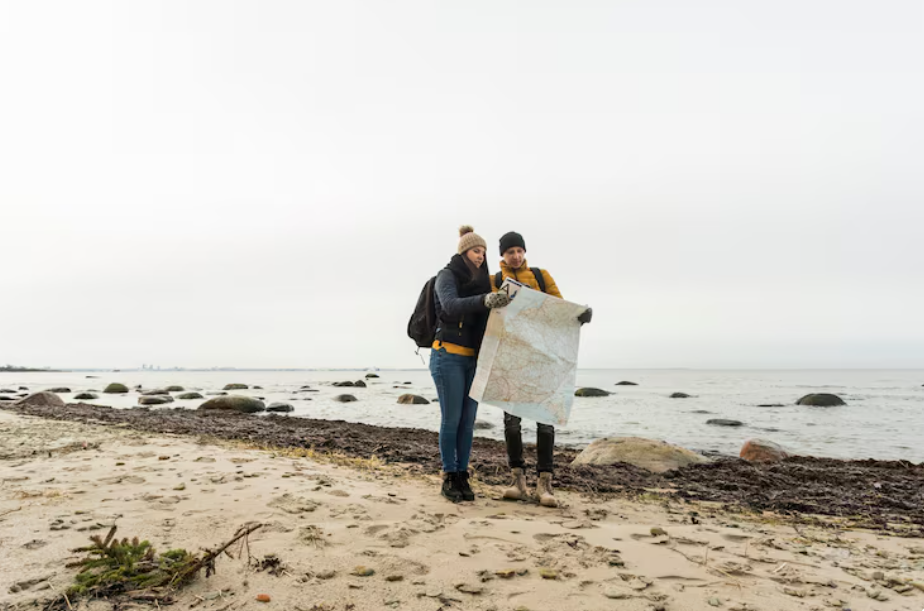
Seldom do shorelines remain in one location for very long. While some changes happen abruptly following storms or human activity, others unfold gradually over decades. It is impossible to predict how a shoreline will change. Coastal consultants employ research, expertise, and observation to determine the current location of the land-water border as well as the expected future location.
Communities, developers, and planners may lower risk and make more informed coastal decisions with the aid of accurate shoreline forecasts.
Reading the Past to Understand the Future
The history of a shoreline is one of the best predictors of its future behavior. Coastal consultants start by looking at the evolution of the shoreline. Patterns that are not apparent from short-term observation can be found in old maps, aerial photos, satellite images, and survey data.
Without assistance, a shoreline that has continuously receded is unlikely to abruptly settle. On the other hand, regions that exhibit seasonal fluctuations but long-term equilibrium can need little intervention. Consultants can determine if change is cyclical, progressive, or accelerated by outside forces by analyzing past trends.
Observing Natural Coastal Signals
Clues on how shorelines react to environmental influences are left behind. Beach width, dune morphology, vegetation health, and sediment properties are all carefully observed by coastal consultants.
Larger changes in the future are frequently indicated by subtle changes in these characteristics. For instance, exposed roots or thinning dunes can be signs of higher erosion pressure. Consultants can predict shoreline movement before significant losses happen by deciphering these natural signs.
Understanding the Forces at Work
Numerous interrelated factors are responsible for shoreline alteration. Coastal experts examine how storms redistribute sediment, how tides transfer water, and how waves approach the coast.
They also take into account offshore factors including nearshore currents and seabed shapes. These factors affect where sand is deposited or withdrawn as well as how energy reaches the beach. Understanding how these forces interact at a particular region is necessary to forecast change.
The Role of Human Influence
Natural processes are just one aspect of the problem. Shoreline change is frequently accelerated or redirected by human activity. Coastal consultants evaluate the impact of adjacent structures, coastal armoring, navigation channels, and dredging operations.
Sediment movement may still be impacted by a jetty or seawall constructed decades ago. Consultants assess how these characteristics affect natural movement patterns and take it into account when making projections about the shoreline.
Using Modeling as a Forecasting Tool
In order to forecast shoreline behavior, modern coastal consulting mainly depends on modeling. Waves, currents, and the movement of sediment under various circumstances are simulated by numerical models.
Using these models, consultants can evaluate the potential reactions of a shoreline to:
- more powerful storms
- Sea levels are rising
- new constructions along the coast
- repair or safety precautions
While modeling can not yield precise solutions, it does help reduce ambiguity and pinpoint potential long-term results.
Accounting for Long-Term Change
Forecasting changes to the shoreline extends beyond the upcoming storm season. Long-term factors like rising sea levels and shifting storm frequency are taken into account by coastal experts.
Consultants create scenarios that illustrate how shorelines can change over decades by fusing historical data with forecasts for the future. For decisions about coastal development and infrastructure planning that must be sustainable for many years to come, this long-term perspective is essential.
Monitoring to Refine Predictions
With observation, prediction gets better. In order to observe how shorelines react to actual conditions, coastal specialists frequently advise continuous monitoring.
Frequent inspections and surveys aid in confirming past forecasts and spotting emerging patterns. As conditions change, monitoring enables experts to modify projections and recommendations, increasing accuracy over time.
Why Shoreline Prediction Matters
Better coastal decisions are supported by accurate shoreline forecasts. It lowers the cost of repairs, prevents development in high-risk regions, and safeguards natural habitats.
Coastal consultants offer the knowledge required to manage change rather than respond to damage after it happens by comprehending how and why shorelines evolve.
Conclusion
Coastal consultants use a combination of science, modeling, observation, and history to forecast coastal change. This procedure turns complicated coastal behavior into useful knowledge. The ability to predict shoreline migration will continue to be crucial for safeguarding coastal land, communities, and ecosystems as environmental pressures rise.